
East Hampton Historical Society To Reopen The Mulford Farmhouse Following Restoration To Celebrate America’s 250th
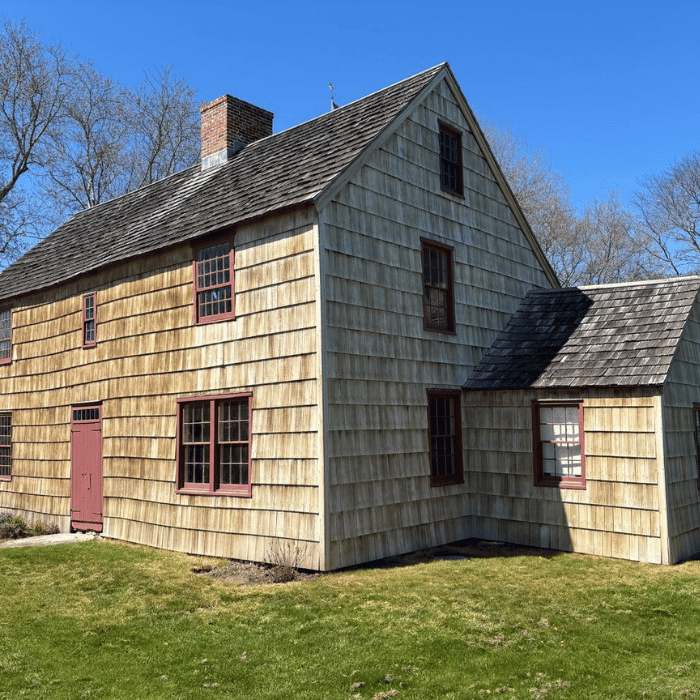
The East Hampton Historical Society has announced the reopening of the Mulford Farmhouse, located at 10 James Lane, on Saturday, July 4, after a comprehensive restoration designed to recreate how the house appeared during the American Revolution.
Restoring the house to its Revolutionary War-era appearance is particularly appropriate because both the exterior and interior layout remain largely unchanged from how they looked in 1776. According to the Suffolk County census, the Mulford Farmhouse was home to sixteen people at that time, including Colonel David Mulford, his wife Phebe, and their six children. The remaining eight residents were enslaved people of color, among them Acca, Daniel, Jack, and Phyllis, whose lives and labor were integral to the household and its operation.
In addition to commanding a militia regiment—Long Island’s equivalent of the Minutemen—and standing among East Hampton’s most prominent American patriots, David Mulford was also the region’s largest slaveholder. Like George Washington and Thomas Jefferson, his story reflects what historian Edmund Morgan called the “American paradox”: how many of the nation’s leading advocates for liberty and freedom also upheld and participated in chattel slavery. By restoring the house to its 1770s appearance, the site offers visitors a fuller understanding of life in East Hampton during the American Revolution, including the essential role enslaved people of color played in sustaining the household during the British occupation.
The first comprehensive interior restoration since the Historical Society acquired the property in 1948, the work entailed carpentry, plasterwork, and painting overseen by award-winning preservation consultant, Robert Hefner. The restoration was based on an in-depth paint analysis of the interior finishes. For example, the investigation revealed how David Mulford arranged to have painters apply an expensive Prussian Blue pigment alternating with a copper acetate on the parlor’s woodwork, which illustrates his wealth and status in the community.
“We’re incredibly grateful for the support of Ralph Lauren, the Ladies Village Improvement Society, Marsha Soffer, and the New York Chapter of Daughters of Founders and Patriots of America for making the restoration possible,” says Steve Long, Executive Director of the East Hampton Historical Society. “Their generosity will enable our community to better understand the role that East Hampton residents played in the American Revolution and founding the new nation. David Mulford, for example, was likely the first people on Eastern Long Island to receive and read a copy of the Declaration of Independence.”
In conjunction with America’s Semiquincentennial this year, East Hampton Town and Village Historian, Hugh King, will lead a special walking tour of East Hampton’s Main Street focused on the American Revolution. Guests will learn where the colonial militia drilled, understand how the British occupied East Hampton, and see the homes of American patriots and Revolutionary War veterans.
The tour will begin on July 4th at 3 p.m. and guests are asked to meet at the Home Sweet Home Museum (14 James Lane, East Hampton). Throughout the summer, the Mulford Farmhouse will be open from Thursday to Monday from 11 a.m. to 4 p.m.