From Southampton to Montauk, the East End’s weekend calendar offers live performances, art, film, fall… Read More →



From Southampton to Montauk, the East End’s weekend calendar offers live performances, art, film, fall… Read More →
A couple’s plans to downsize from their longtime Sag Harbor home took an unexpected turn,… Read More →

Peconic Bay Medical Center will provide free breast exams and mammograms for eligible participants, with… Read More →

The Bridgehampton catering favorite brings East End ingredients, farm-fresh turkeys, inventive sides and homemade desserts… Read More →

Rich suede, supple leather, and bohemian rock ’n’ roll details set the tone for the… Read More →

The former social studies teacher and soccer coach posed as a teenage boy on Snapchat… Read More →

Kevin Menard’s Main Street wellness shop is preparing to close by Dec. 11, leaving loyal… Read More →

Forget the basic Hamptons sweatshirt. This autumn, while everyone is here for pumpkin patches and… Read More →

The 11th annual festival, Oct. 21-22, will honor Anthony Anderson, Kate Walsh and Denée Benton,… Read More →
From Benedict Cumberbatch in Frankenstein to The Rocky Horror Picture Show, An American Werewolf in… Read More →

For 30 years, Judi Desiderio, who is the Senior Vice President at William Raveis, has tracked East End home sales closely. She treats it like creating a personality profile. This year, she looked at the numbers again. She thought it would be the same old story, such as the Hamptons getting more expensive. But she found something strange. The market didn’t just change, it completely changed.

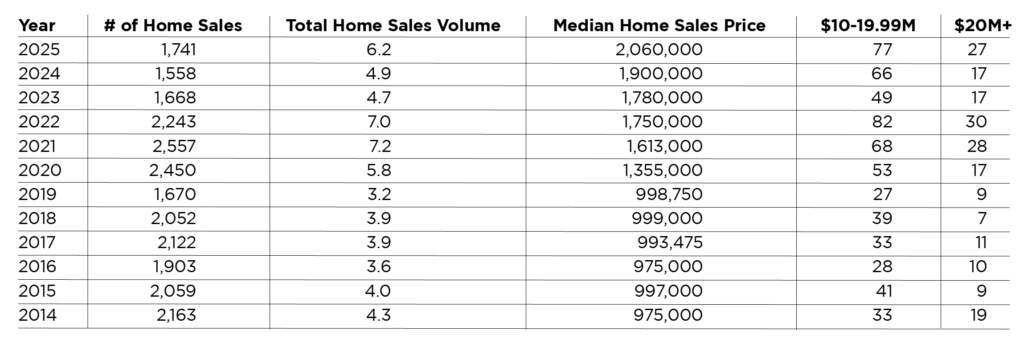
From 2014 to 2019, the median home price stayed around the high $900,000s. It didn’t really go up. This went on for six years. If you think the Hamptons is always going up and to the right, this is where you start to question things.
Desiderio went back further to 2005, when the median was $860,000. By 2019, it had only gone up about 15 percent over fourteen years, which is a very small increase for the Hamptons. So what happened? Did the East End suddenly become affordable?
Not really.
After 2019, the market seemed to wake up, and the median started to rise until 2025, when it jumped to over $2 million, which is a big change within five years.
Meanwhile, the number of sales started to decrease. For the last ten years, the market usually had more than 2,000 home sales a year. But then 2019 went down to 1,670. In 2023, 2024, and 2025, sales went down by more than 25 percent each year. Desiderio mentioned that she hasn’t seen three years of decline like that before. Less supply and higher prices are the classic case of limited availability meets desire, Hamptons style.
The interesting part is that the high-end homes didn’t just do okay, but they kept getting more in demand.
The $10 million to $19.99 million range is where you start calling them properties instead of houses. Sales in this range have gone up every year for six years, from 53 in 2020 to 77 in 2025. The exception was 2022, with 82 sales. Even though the market was slowing down, this area was still doing well.
As for homes over $20 million, Desiderio says that they act how you would expect. It depends on how the financial markets are doing. If stocks are up, then deals happen. If markets are shaky, then people wait, which means the wealthy still shop, they just change when they do it.
So, how do you match the strange plateau from 2014 to 2019 with the later increase?
Desiderio explains that the number of homes under $1 million kept getting smaller each year. Since fewer lower-priced homes sell, the median can seem steady even if values rise overall. The median isn’t a hard number; it’s just the middle of a changing set of numbers.
Desiderio thinks that values have been rising every year for the last ten years, and the last drop was in 2008 and 2009 during the Great Recession. It wasn’t just the market that changed, but what the market was made of. There are fewer starter homes and more expensive houses. The luxury part keeps growing.
The Hamptons haven’t gotten hotter, but it’s become harder to get into. If you’re looking at the numbers and wondering how things got so crazy, it might just be that there’s less available.