Hamptons home prices fall as North Fork prices hit record highs. Real estate analyst Jonathan… Read More →



Hamptons home prices fall as North Fork prices hit record highs. Real estate analyst Jonathan… Read More →

The New York Times bestselling author celebrated the release of “Your GLP-1 Game Plan,” a… Read More →

Greenport’s Oyster Fest, a classic car show in Cutchogue, an Orient art exhibition and vineyard… Read More →

Wednesday nights in the Hamptons can feel like a toss-up: stay in and keep telling… Read More →

Big names, striking work and a major photography auction — five reasons to head into… Read More →

Amanda Seyfried, Alec Baldwin, Nina Dobrev, Trudie Styler and more hit the Hamptons for a… Read More →

Julia Louis-Dreyfus makes her Broadway debut, Billy Crystal gets personal and Aaron Sorkin returns to… Read More →

Hollywood stars, Montauk’s chowder contest, Wölffer’s Harvest Party, ARF’s Dog Walk and Judy Carmichael lead… Read More →
Hello, Target. Goodbye, Lidl. As both stores make news on the same Sunday, Giunta’s takeover… Read More →
Bruce Springsteen’s E Street Band guitarist adds nearly $4 million to the asking price of… Read More →
If you really want to get a grip on the Hamptons real estate market right now, forget about the median sale price for a minute. Start with the homes you can’t buy, such as the ones that don’t even show up in listings. That’s where the action is.
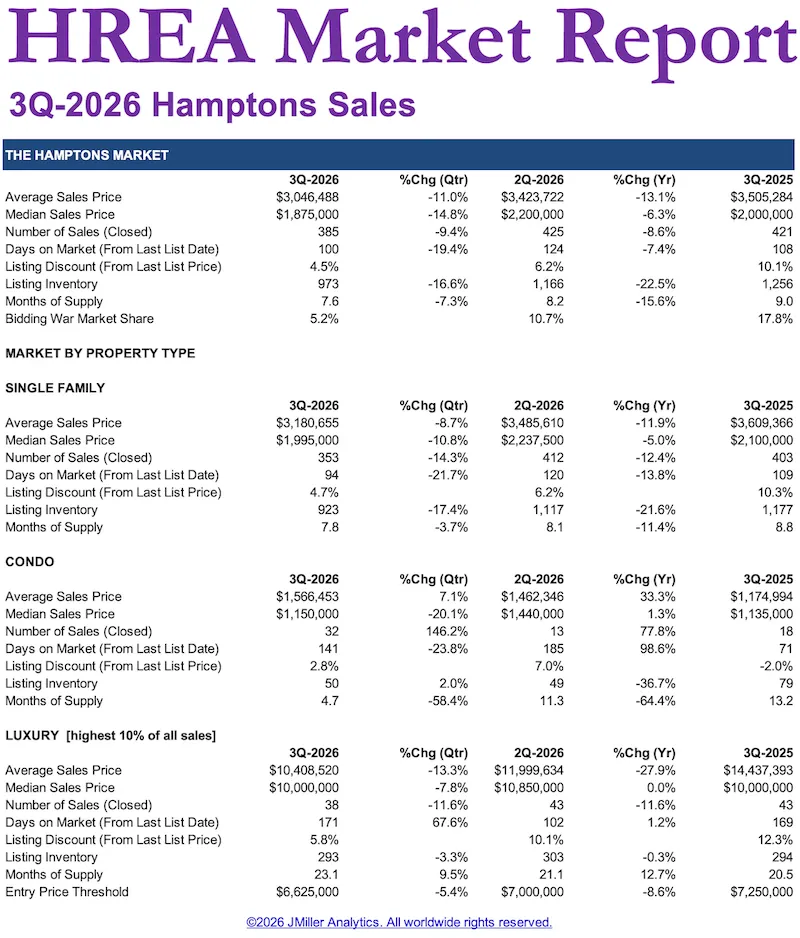
The numbers for the third quarter of 2026 — covering the Hamptons, North Fork, and Long Island — tell the same story: there just aren’t enough houses for sale. Homes are scarce, sales are slower, and the properties that do sell are getting clustered into certain price brackets.
When you hear about market stats, remember: they don’t reveal what buyers would like to pay, but they reveal what buyers can actually get their hands on.
After nearly two decades spent analyzing these markets by Miller, this latest quarterly report reads like something new. Now Long Island’s numbers are in the mix. The thinking? Compare and contrast. The bigger picture helps explain what’s happening out east.
Here’s the punchline that looks misleading: “Hamptons median sales price is down.” Specifically, it dropped 6.3 percent year-over-year to $1.875 million. That sounds like things are cooling off, right? They’re not.
If you squint at the trend, it looks like prices are falling, but really, the mix of homes sold shifted. The median price had spent six straight quarters hovering near record highs, but this quarter, more homes moved in the middle market, fewer at the top end.
Numbers can fool you. The $1 million to $5 million segment — that so-called “Hamptons middle” — made up 65.5 percent of all sales, the third-highest share ever. Meanwhile, homes above $5 million got a smaller slice than they’ve seen in over a year.
The median dropped not because everyone got a deal, but because the shopping cart had more center-cut steak and less caviar. If you glance at the receipt, you’d miss the menu.
Of course, the real headache is supply. Third quarter saw Hamptons listings fall, again, way below typical levels for this time of year. Sales fell for the fourth consecutive quarter. Not hard to see why: you can’t sell what isn’t on the market.
And despite the old wisdom that says limited inventory should shoot prices upward, what’s happening here is much more complex. If top-tier homes aren’t selling, but mid-tier ones are, the median drops, even if everything’s still expensive and competition is cutthroat.
So: the market isn’t crashing. It’s bent out of shape.
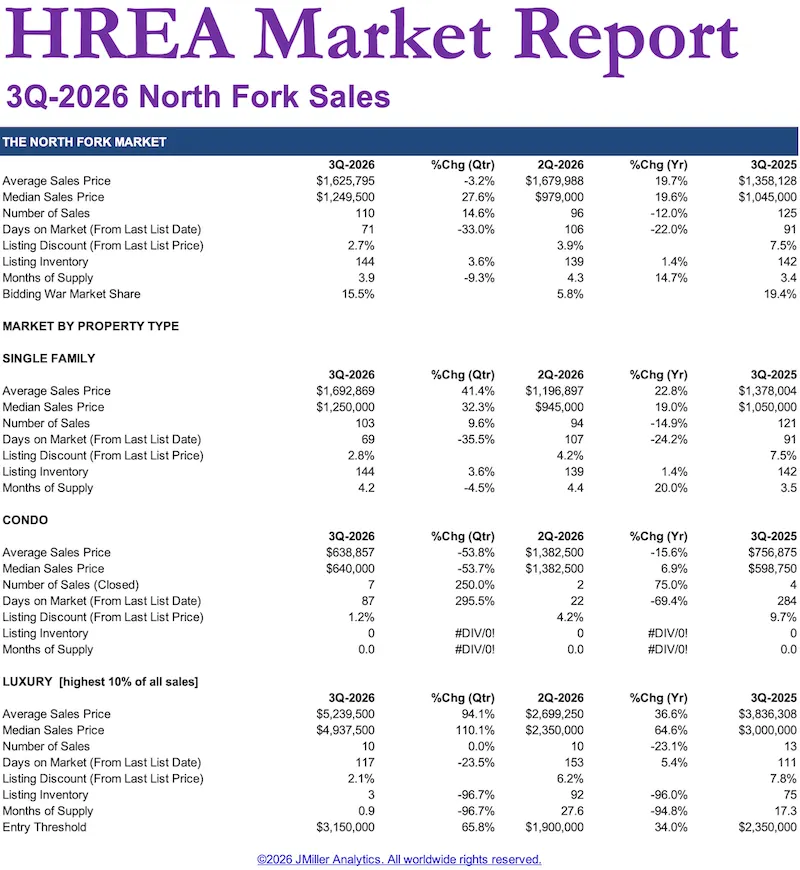
North Fork, on the other hand, is having a moment. The numbers don’t need much decoding. Prices are rising fast. Median sales price shot up nearly 20 percent, hitting an all-time high at $1,249,500. The average price soared almost 20 percent, too. Now, six out of ten homes on North Fork sold for over $1 million, which is the highest percentage ever.
And yet, the inventory is pitiful. Just 144 listings — barely more than last year, but still less than two-thirds the typical amount. Technically, supply grew, but in reality, there’s not enough to satisfy demand. Sales dropped again, for the third time. You get the weird mix: fewer sales, higher prices, more million-dollar deals. The word here is scarcity. It’s steering everything.
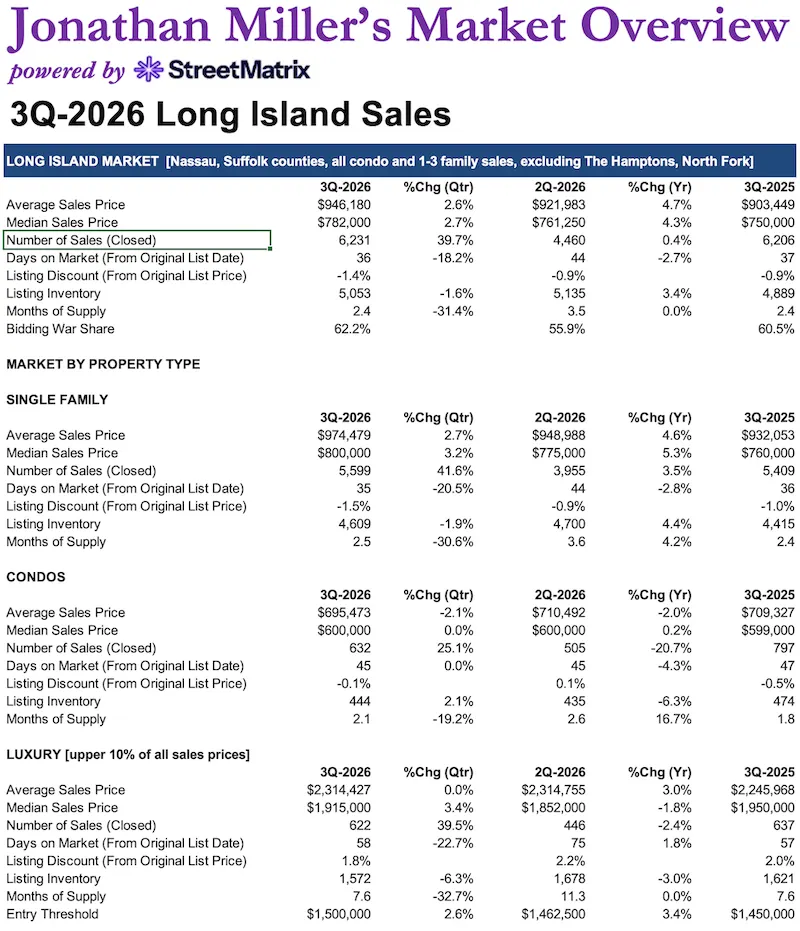
Over on Long Island, the pattern repeats, just with lower digits. Median sale price climbed 4.3 percent to a new record: $782,000. That’s eight quarters straight at record highs. All this, even with mortgage rates climbing.
Inventory looks slightly up — 5,053 listings, an increase on paper. But step back and realize: it’s still way below the average. Thirty-six percent under the decade’s third-quarter norm. More listings than last year, but nowhere near enough to match demand.
This region-wide trend makes another thing clear: the return of bidding wars. Now, more than half of Long Island sales turn into a battle. And look at listing discounts: rather than buyers whittling down sellers, prices are being pushed up. When inventory’s healthy, buyers wander and choose. When it’s scarce, buyers pounce.
Guess which situation we’re in.
Luxury lives in its own universe, as usual. Homes listed above $6.625 million held steady in number, but prices jumped almost twice as quickly as the broader market. This alone explains why fixating on a single median is so foolish. The Hamptons isn’t just “one” market; if it ever was, it isn’t now. There’s the mid-market. There’s the ultra-luxury. Some homes sell in a snap because they’re priced right, while others linger for ages because they’re not. Some buyers wait months, years even, for a property that never appears.
The most valuable thing in real estate has become the listing itself. Scarcity isn’t just distorting prices. It’s distorting everything: sales, stats, psychology, even how we talk about the market.
Hamptons’ falling median doesn’t mean a bargain hunt in Montauk just got easier. North Fork’s skyrocketing median doesn’t mean buyers suddenly lost their minds. Long Island’s records? Not just about demand — it’s about supply, or lack thereof.
All three markets are grappling with the same issue. Not enough houses. Until that changes, expect the market to stay weird.
One last thing for the sellers out there: In a market this tight, the buyers are real — they’re out there. The question is whether your house is the one they can actually see.
That means the real trick isn’t just having a nice house. It’s getting people to notice it. When every listing matters, grabbing attention is as good as gold.
There’s more than one way to get noticed. Sometimes, the market rewards creativity more than square footage.
Learn more about Jonathan Miller’s work at www.housingnotes.com.