From legendary lobster shacks to polished waterfront tables, these are the places where the East…
Read More →
Angela in America: Why Gloria Steinem Mattered — On Equality, Humor and Hope
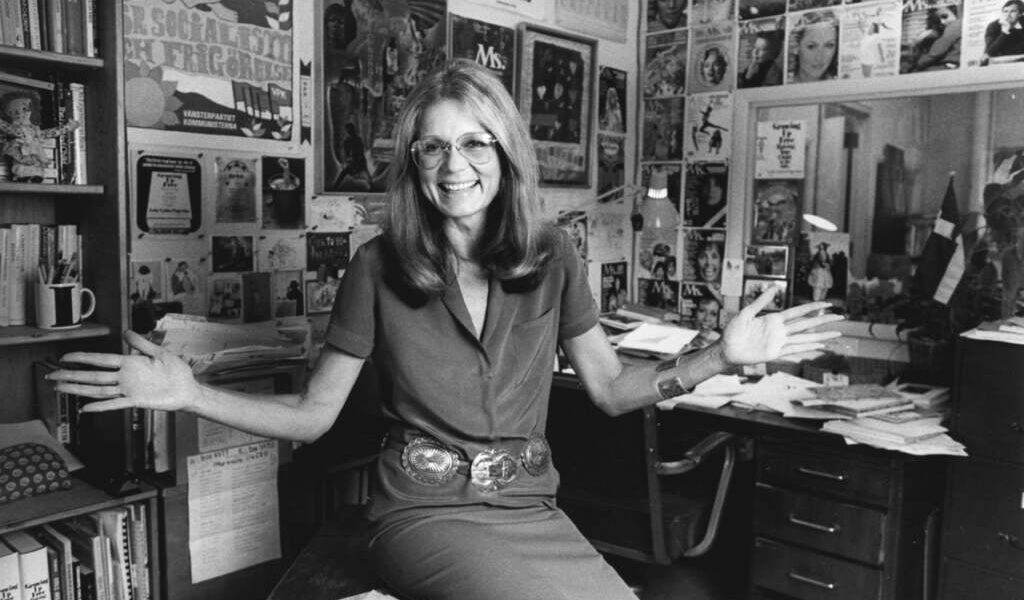
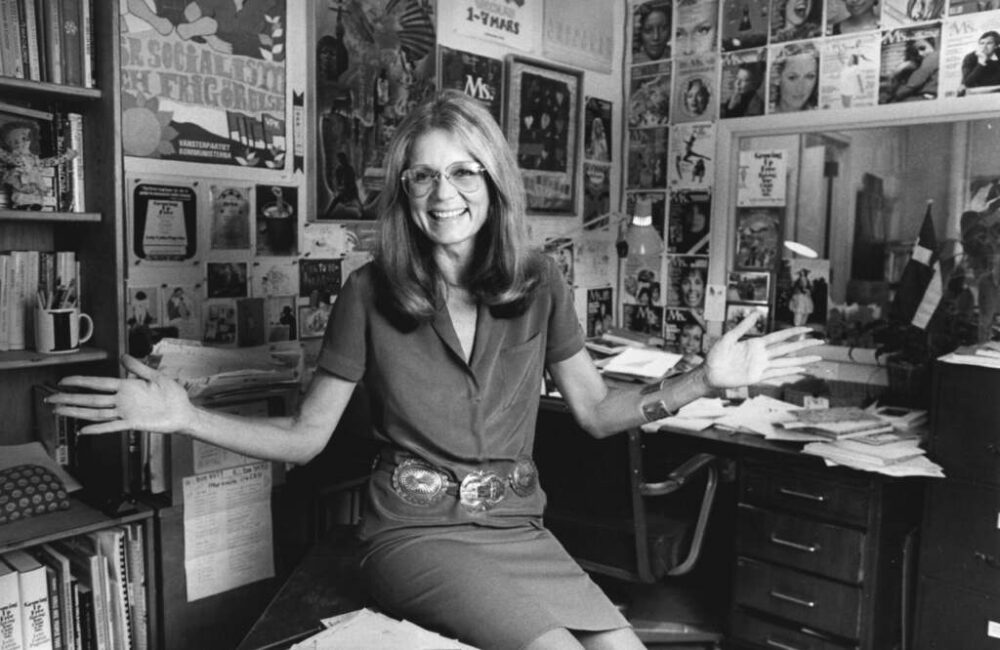
Gloria Steinem in Ms. office. People Weekly, November 21, 1983. (Reproduced with permission from photographer). Copyright 2001, Marianne Barcellona.
SPARK Editor Angela LaGreca remembers meeting the feminist icon, reflects on the change she helped ignite and pays a visit to Steinem’s longtime New York City home after her death.
I was brought up to never idolize anyone, but I did love and admire Gloria Steinem. Her brain. Her passion. Her chutzpah. Her determination to fight for equal rights for women and, in essence, the broader mission — equality for all. How hard is that to grasp? About as hard as it has been to achieve.
To me, Gloria Steinem was a rock star in every way, though she never uttered a note. But her voice carried. Her fame, or to some, her infamy, lives on because she dared to speak and write about women’s rights at a time, around 1969-70, when it wasn’t ladylike to do so. To say women had rights at the table, in the boardroom, in the workplace. That they should be paid the same as men for the same job, that they had freedom of choice over their bodies and their lives.
Gloria Steinem in Ms. office. People Weekly, November 21, 1983. (Reproduced with permission from photographer). Copyright 2001, Marianne Barcellona.
Meeting Gloria Steinem
I first met Gloria in 1991 when I was the warmup comedian at a talk show called Attitudes on Lifetime television; she was a guest on the show. As a Smith College graduate, I knew Gloria, Class of ’56, was one of its most famous alums. I did a joke about going to school there, saying the only thing that stuck with me after four years at Smith was when the president of the college said to the graduating class, “Ladies, ladies, never be embarrassed to hire someone to Clean. Your. House!”
“House?” I thought. What house? I walk into a handicapped bathroom in New York City and think, “This looks like a studio apartment — I’ll take it!”
Afterward, Gloria came up to me and said, “Wow, Smith must have really changed to have produced someone like you.”
I took it as a compliment at the time, never questioning what she meant. Ah, the brash confidence of youth. But I knew Smith had been pretty uptight and rigid during her years there.
Many were surprised to learn that Gloria Steinem had such a good sense of humor. I always thought she was a cool, inspiring person with a great sense of humanity and humor, despite that kind of sad look in her eyes.
Gloria Steinem, Ms. Foundation benefit at Carolines comedy club, NYC. 2016. Photo: Angela LaGreca
The Ms. Foundation Benefit at Carolines
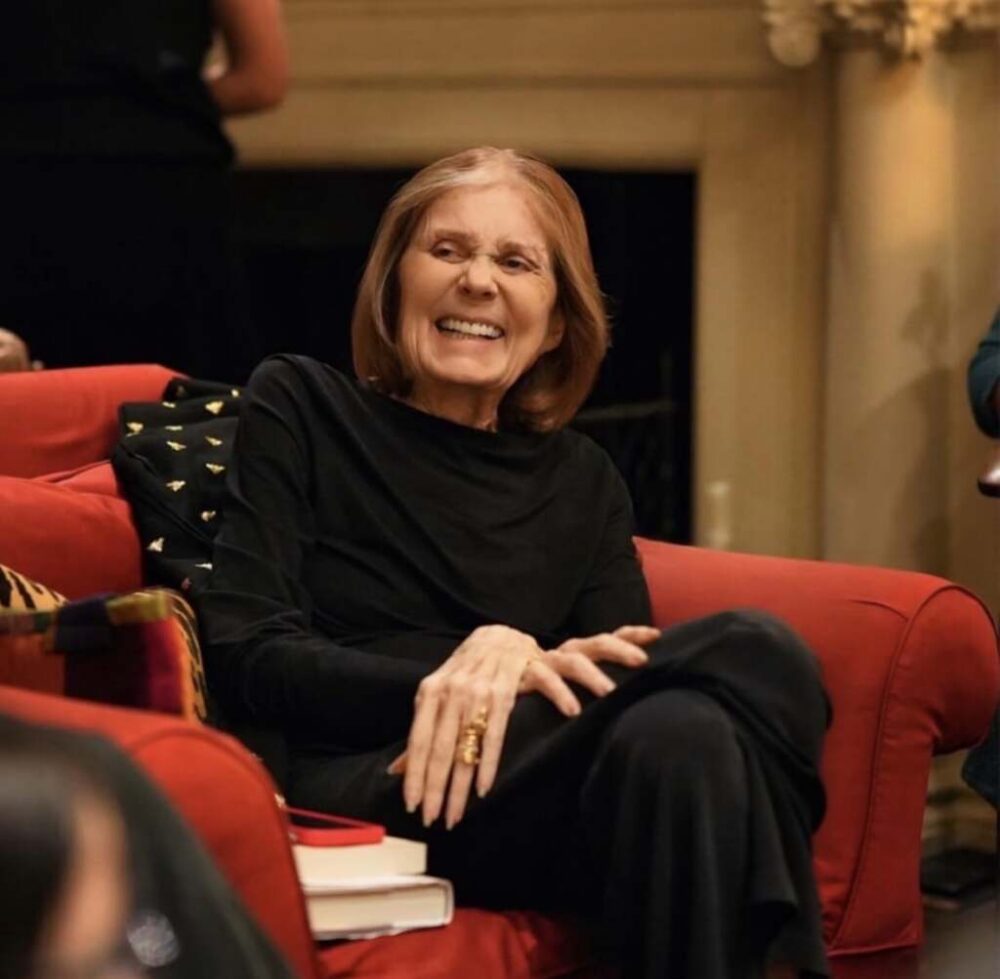
Ten years ago, at the annual Ms. Foundation comedy benefit at Carolines comedy club on Broadway in New York City, I was in the audience when Gloria got onstage and talked about how comedy is the only “free emotion” — versus love, which can be “coerced.” It got a big laugh.
I also learned that night at Carolines that Gloria was once a comedy writer for NBC’s groundbreaking political satire That Was the Week That Was, earning an Emmy nomination as part of its writing team. In 1965, Gloria contributed a recurring segment called “Surrealism in Everyday Life.”
I couldn’t help thinking that her view of the world must have often felt surreal.
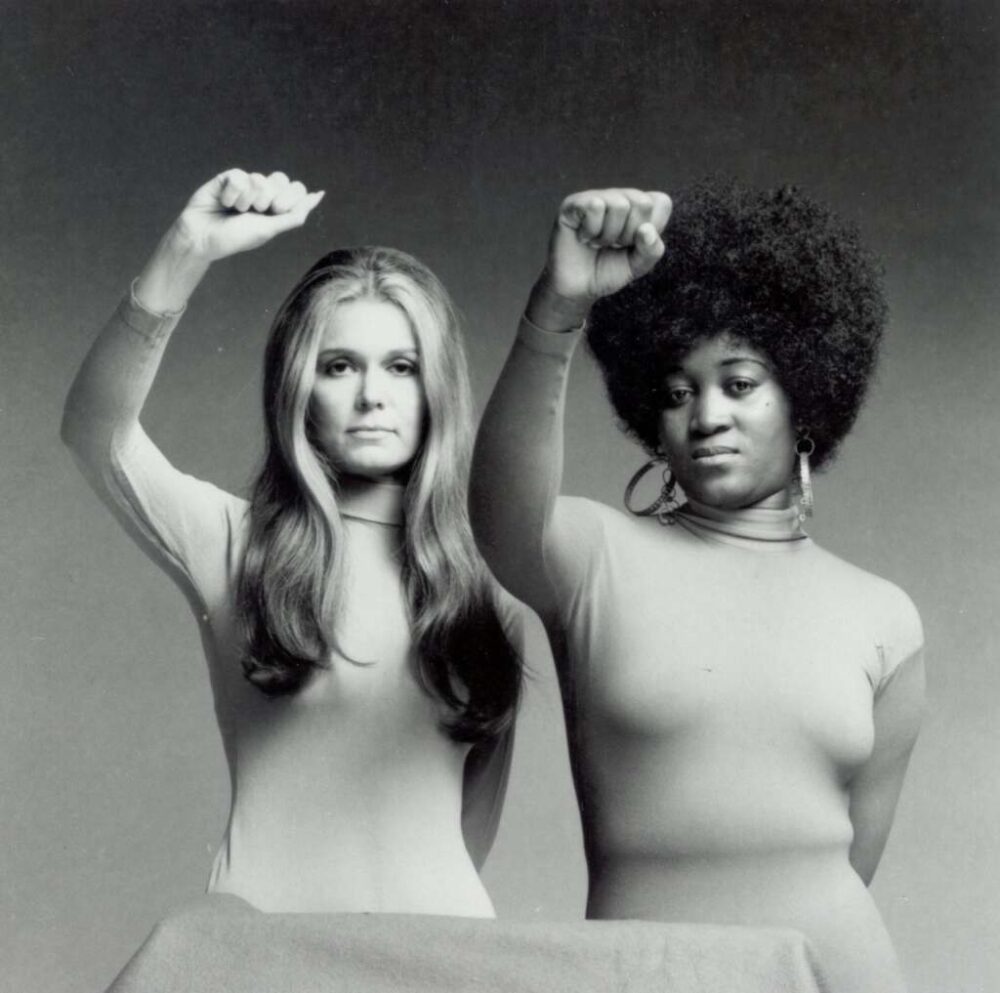
Gloria Steinem and Dorothy Pitman Hughes, circa 1970. Photograph by Dan Wynn. Gloria Steinem Papers, Sophia Smith Collection, SSC-MS-00237.
Isn’t the concept of “equality for all” a no-brainer? Yet senseless acts of inequality in the United States — an imperfect, but arguably still the greatest democracy in the world — persist. And Gloria persisted.
How Times Have Shifted
I remember the days when men were served first at the dinner table. It was a customary nod to the head of the household. The fuss. The clamor. The king of the castle eats first. It was as if trumpets blared when the meal came out and the first helping was handed to the man of the house.
And then came the shift. I can’t remember exactly when it happened. I was young, maybe the mid-’70s or early ’80s, but the serving of dinner first to the man of the house suddenly felt awkward, wrong, weird. It was a small detail, perhaps, in the bigger scheme of inequality, but it was telling.
Many blamed the shift on “those women libbers” like Gloria who raised awareness and consciousness. The words “activism” and “feminism” got a bad rap. Nothing elegant and sexy about an activist — that sounded militant and angry. No one wants to give up the top seat at the table. But slowly, change was a-comin’.
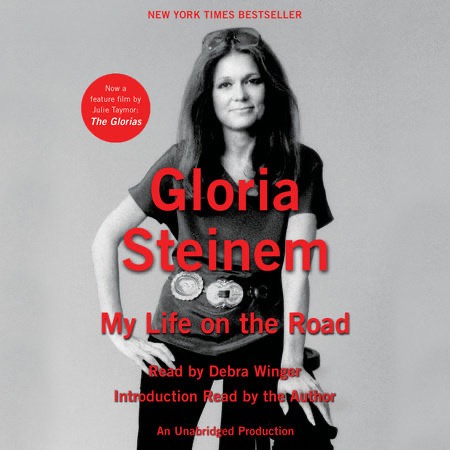
Gloria Steinem, “Myl Life On The Road”. 2015. Penguin/Random House
Gloria Steinem’s Gatherings and the “Talking Circles”
Gloria had a knack for gathering and mobilizing great minds. She helped found the National Women’s Political Caucus in 1971, campaigned for the Equal Rights Amendment and co-founded Ms. magazine, bringing women’s lives, rights and ambitions into the national conversation at a time when women journalists were often confined to traditional female subjects.
Skeptics said Ms. wouldn’t last more than six months. Its 300,000-copy national test issue sold out in eight days. More than 50 years later, it’s still publishing.
And the needle did move. When Gloria emerged as a leading voice for women’s equality around 1970, women working full time, year-round earned roughly 59 cents for every dollar earned by men. Today, it’s about 84 cents.
Women still face a promotion gap: Recent research found that for every 100 men promoted from entry-level positions to manager, 93 women were promoted, and women hold only about 29% of C-suite positions in the large companies studied.
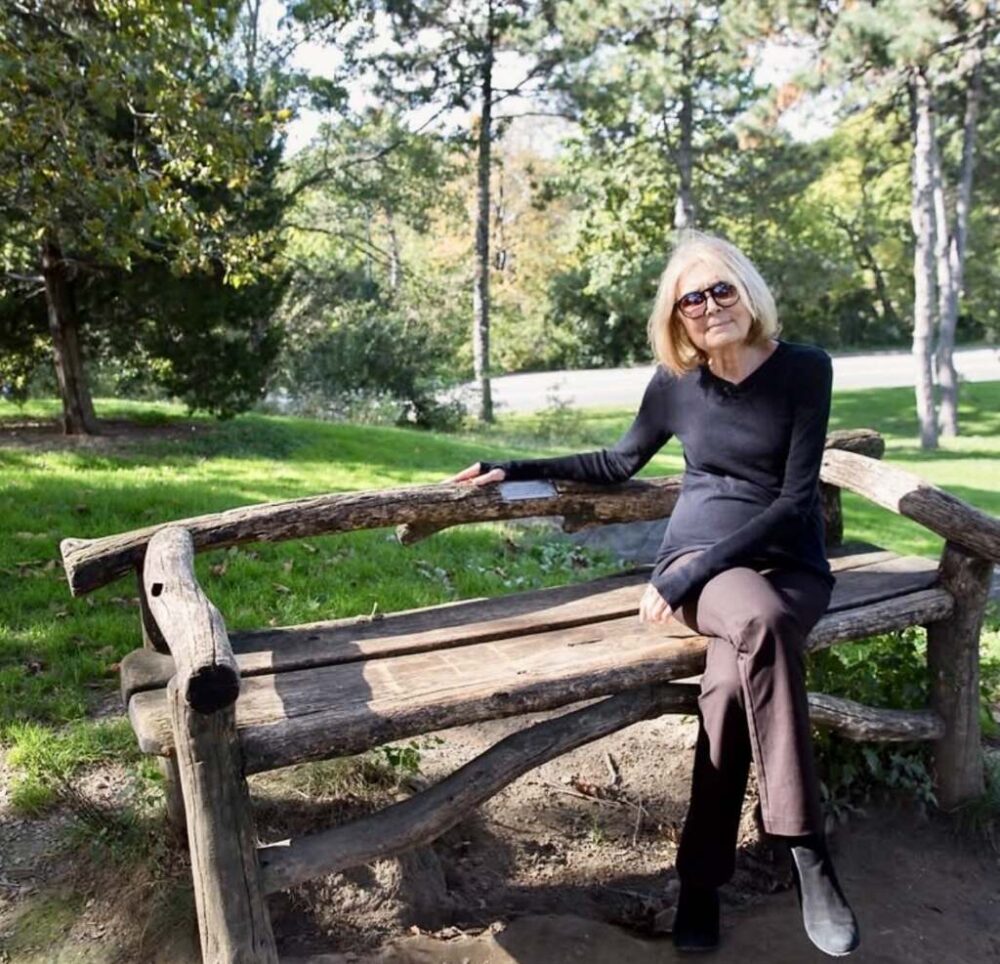
Gloria Steinem on a bench gifted to her in Central Park by friends for her 80th birthdayl. One of her most “prized possessions” and “a gift for all of us: a bridge through time and history,” according to her Instagram. Photo: IG @gloriasteinem. Photo by Katie Lyman for @gloriasfoundation
Nothing is perfect and progress takes time, and its toll. But there has been change. Hard-fought change. And Gloria Steinem was instrumental in the movement to effect that change.
The Importance of Hope
Today the world feels less bright to me without Gloria Steinem. I almost wrote “less hopeful” because that’s how I felt upon hearing of her death, at age 92, on Sept. 2. But I had to catch myself. Not good to lose hope. And besides, Gloria was an avowed “hope-a-holic.”
Hope, in Gloria’s mind, wasn’t just wishful thinking.
She talked of hope in her interview for the Netflix series Famous Last Words, recorded confidentially with the understanding that it would be released only after her death.
“I don’t lose all hope in the future,” she said.
And in her final memoir, An Unexpected Life, out Sept. 22, Steinem reflected on how much consciousness had shifted — and how many dreamed-of changes had actually come to pass over the decades.
Gloria Steinem, “An Unexpected LIfe,” out Sept. 22. Random House Books
“People often ask me how I stay hopeful. I always explain that hope is a form of planning,” she wrote. “I think about twenty, thirty, even fifty years ago and the leaps of consciousness I’ve experienced because of the women’s movement. Some of what we dreamed of decades ago is now really here.” — Gloria Steinem
A Visit to Gloria Steinem’s Home
I knew I needed to go visit her home on East 73rd Street, where she had lived for more than 50 years. Her home was a hub of humanity, a permanent meeting place where Gloria regularly gathered thinkers, activists and political luminaries. The living room that birthed Ms. magazine. The place where for decades, she conducted “talking circles” to discuss social issues of the day.
Those “talking circles” will live on, according to a report in the New York Times. And three floors of the five-story townhouse will become part of Gloria’s Foundation . Good, I thought. Reading that her home will continue as a space for gathering, organizing and activism, gave me hope.
Gloria Steinem photo posted on Instagram, announcing her passing, Sept. 2, 2026. Photo by @giamckenna for @gloriasfoundation
Six days after Gloria’s passing, I told my 12-year-old daughter we were going to take a walk. We live on East 80th Street, and even though I often say I don’t like to go more than five blocks north or south of my apartment — this happens when you live in the city for 30 years — we were making an exception.
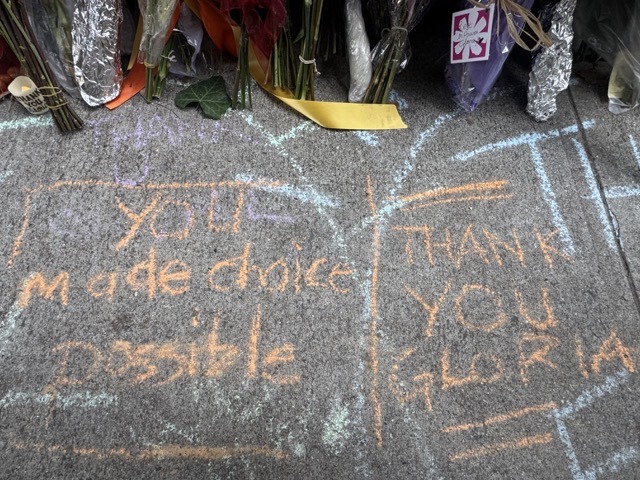
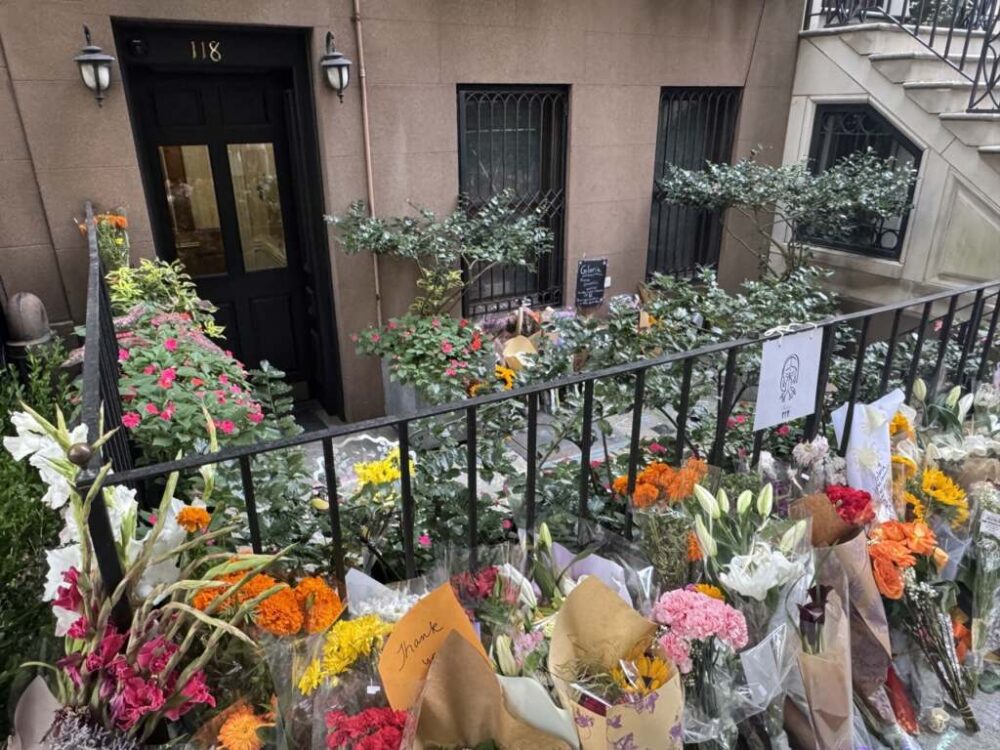
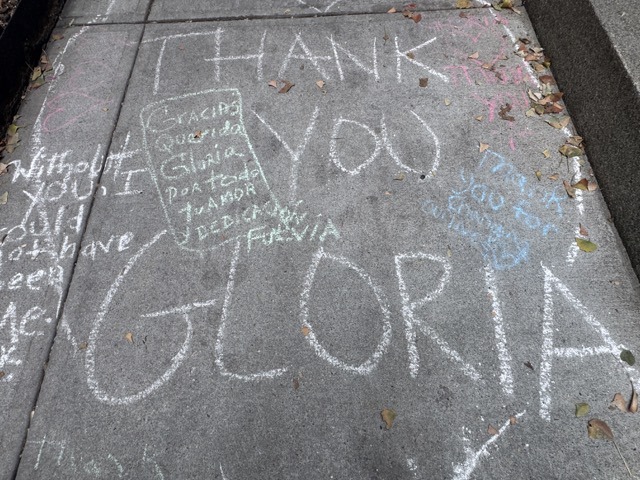
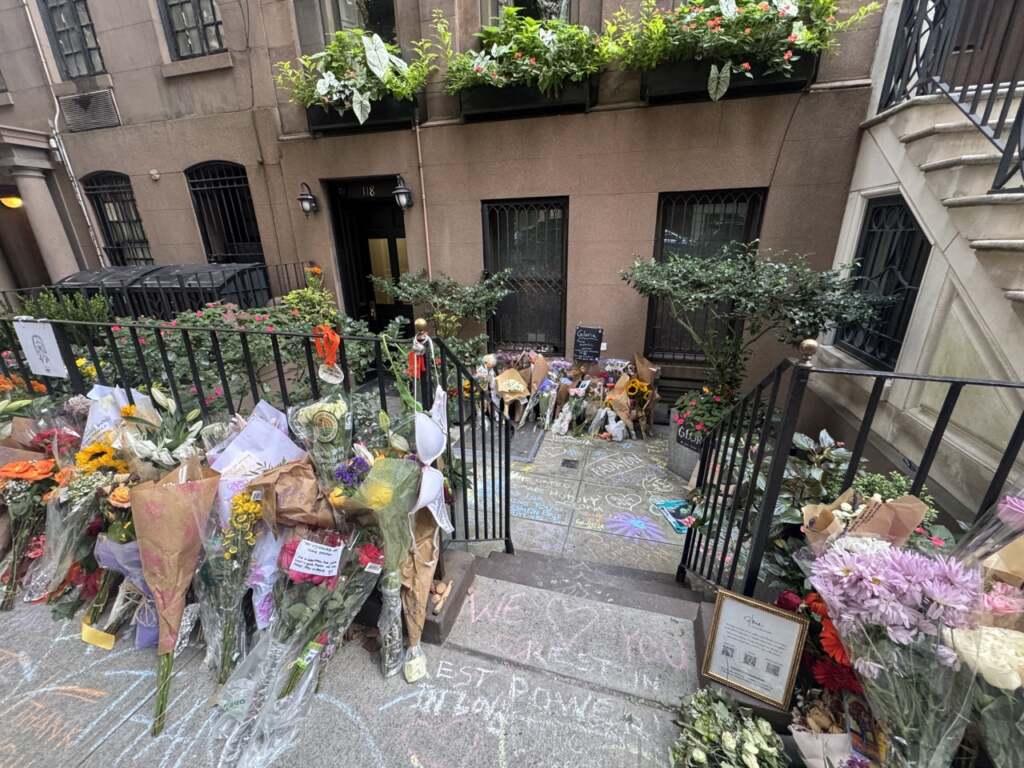
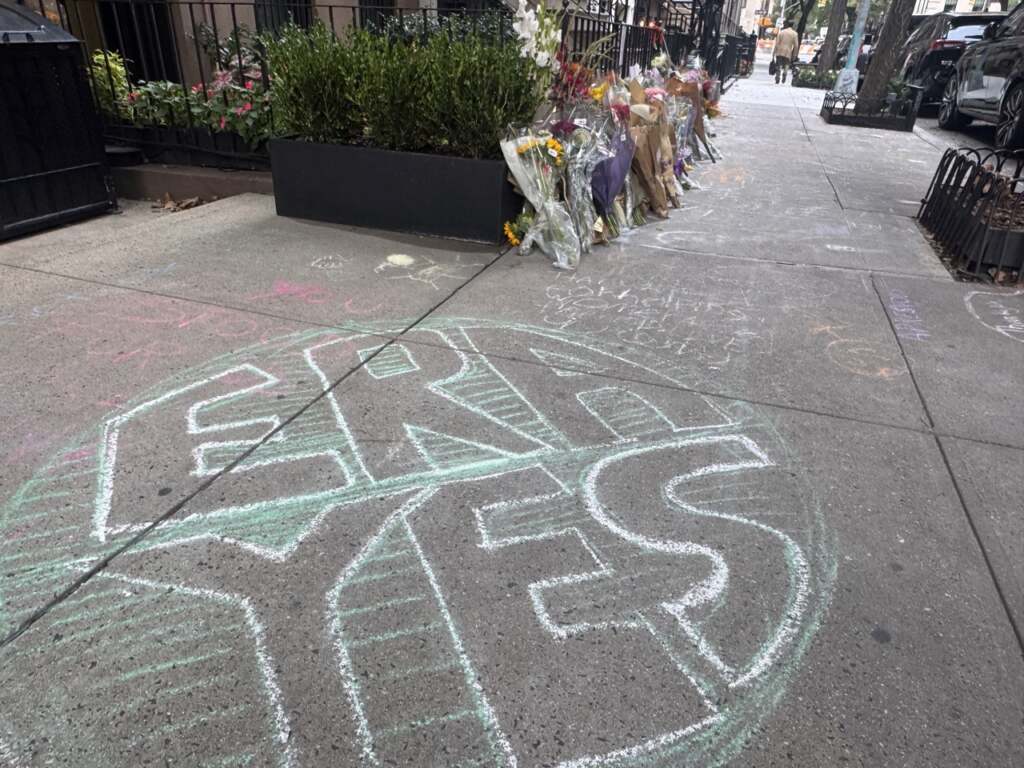
When we arrived at Gloria’s townhouse on 73rd between Lexington and Park avenues, the memorial to her legacy was etched in chalk on the sidewalk by fans who paid their respects.
Gloria Steinmen’s townhouse on East 73rd St, NYC. Photo by Angela LaGreca
“Thank you for your bravery.”
“Thank you for changing our world.”
Gloria Steinem’s townhouse on East 73rd St, NYC. Photo by Angela LaGreca
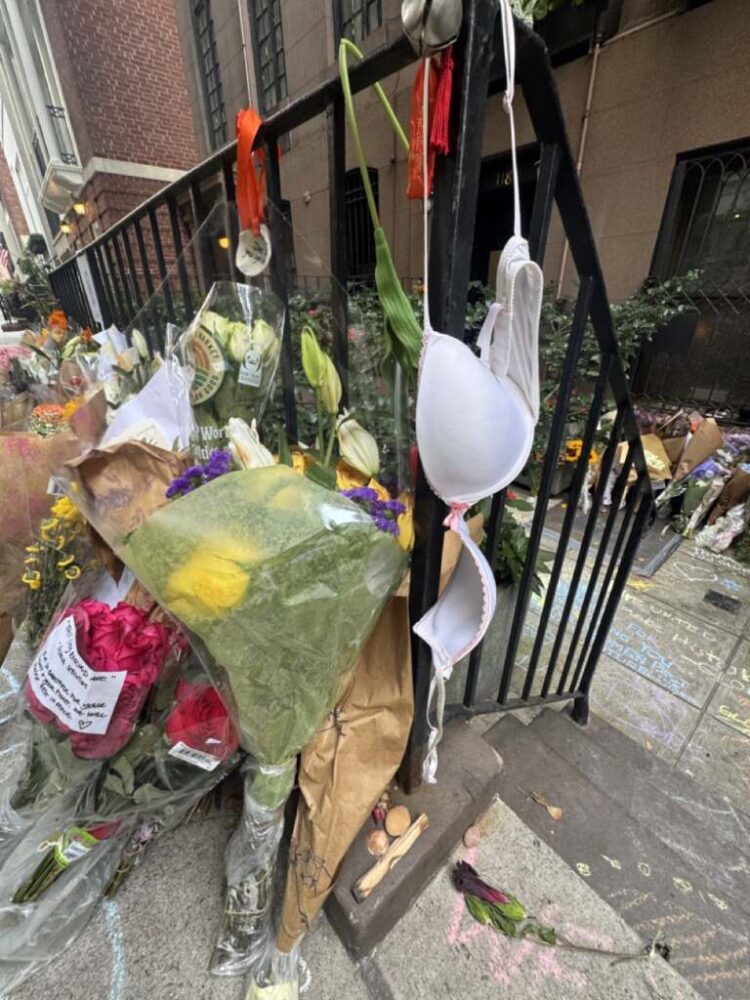
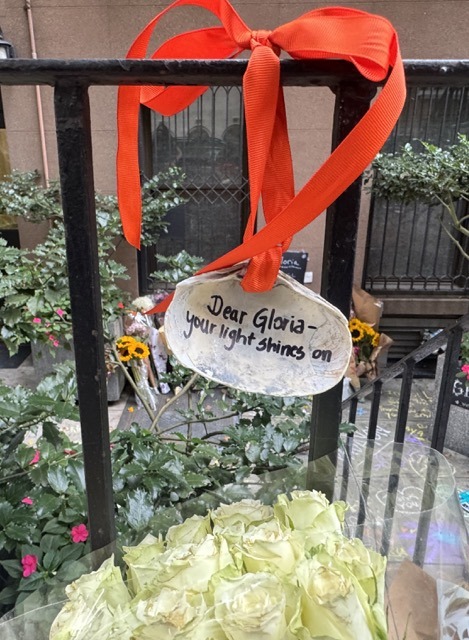
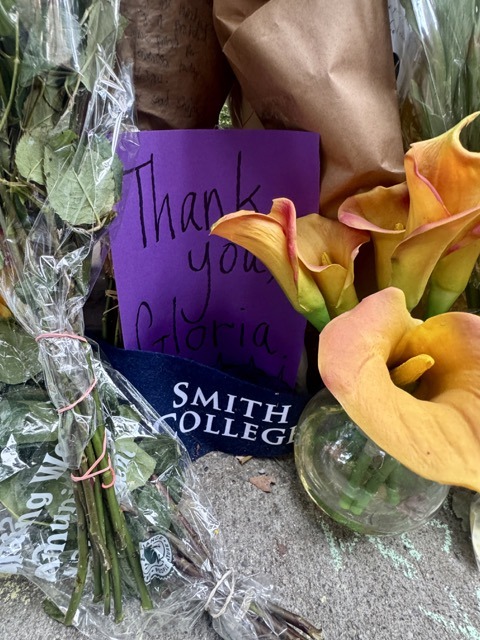
Bunches of flowers surrounded the house and gate. Notes like “Gloria, your light shines on” and “You’ve inspired me to change the world, one word at a time. RIP” were written in her honor. A bra was hung from the gate, a physical reminder of the bra-burning times of the feminist movement.
Gloria Steinmen’s townhouse on East 73rd St, NYC. Photo by Angela LaGreca
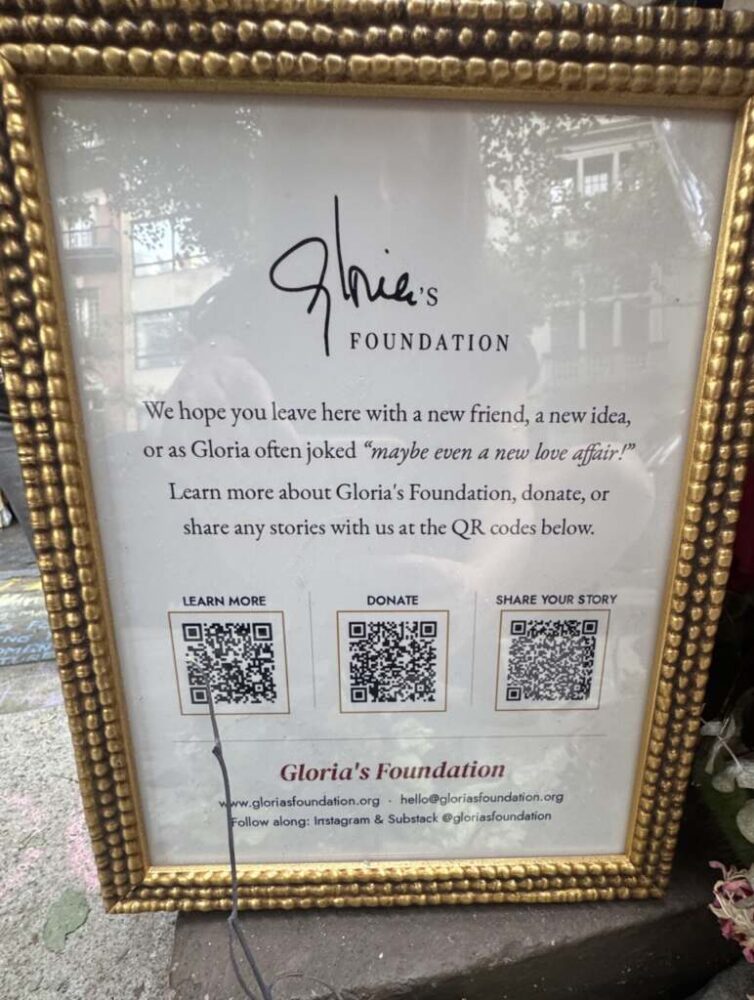
A framed note from Gloria’s Foundation read in part, “We hope you leave here with a new friend, a new idea, or as Gloria often joked, ‘maybe even a new love affair.’”
Sign outside Gloria Steinmen’s townhouse on East 73rd St, NYC. Photo by Angela LaGreca
Two women pulled up in a van. Turns out they were delivering high-end floral bouquets to clients. They seemed mesmerized by the display and pulled out their iPhones to take pictures.
They asked who Gloria was, and why all the flowers.
I did my best to summarize Gloria’s life and impact, mumbling about all she did to help further equality for women and all people, what she meant to the world, to the women’s movement and to the future of someone like my young daughter.
The women smiled and took video. Then one of them went to the back of their van and pulled out a few flowers from the bouquets they were scheduled to deliver elsewhere — and placed them outside Gloria’s house.
“I had to do this,” she said.
Gloria Steinmen’s townhouse on East 73rd St, NYC. Photo by Angela LaGrecaGloria Steinmen’s townhouse on East 73rd St, NYC. Photo by Angela LaGreca
They got it. They felt it. The presence. The impact.
And then one of them said what I had been thinking.
“It’s amazing how fresh these flowers all are, after being here for several days.”
She would know, being in the flower business. It was true. The bouquets seemed perfect, no sign of wilting. They were fresh and beautiful, ageless and defiant.
I guess the word is hopeful.
Thanks, Gloria. You rock on.
Gloria Steinem’s memoir, An Unexpected Life comes out Sept. 22 (Random House Books, 2026).
According to her Instagram, in lieu of flowers, “Gloria has asked that those wishing to honor her with a gift, may make a donation to Gloria’s Foundation.”Gloria Steinmen’s townhouse on East 73rd St, NYC. Photo by Angela LaGreca
Angela LaGreca, Editor-in-chief and co-Founder/Publisher of Spark Hamptons, is a four-time Emmy Award-winning journalist, producer, writer and comedian/host. Her TV credits include NBC’s “Today,” ABC’s “The View,” and, most recently, the primetime cable news program “Cuomo” on NewsNation. On the East End, she was the Creative Director at LTV, VP Features/Events/Photo Editor at Dan’s Papers, and has performed at Guild Hall, Bay Street Theater and the WHBPAC. Her publishing career began at Modern Photography, where she was managing editor. LaGreca lives in Manhattan and East Hampton and can be reached at angelatvmedia@gmail.com and angela@sparkhamptons.com
.